| |
|
|
| |
|
|
 |
|
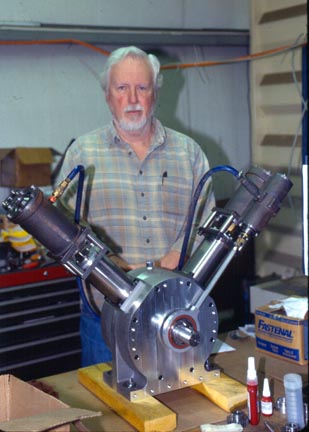
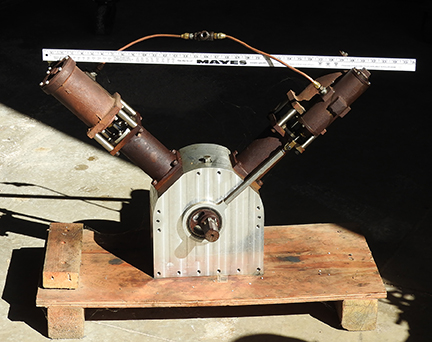
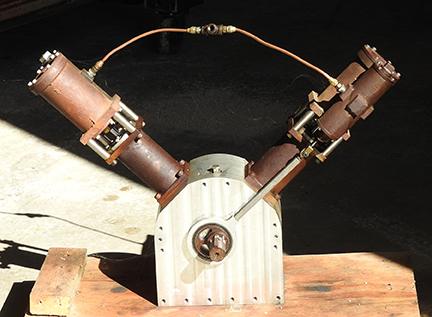
The engine is a 3” bore and 4” stroke, double acting, simple, piston valve steam engine with a cylindrical cross-head and no Stephenson reversing link, hence no variable cutoff. The engine is de-tuned to 20 hp by using 200 psi steam and running at 750 rpm because it was designed to run for ten thousand hours. At higher rpm and steam pressure an engine of that size can easily produce 75 hp. We do not know if the bearings will handle that or if it is balanced properly. Otherwise it is a nice looking engine.
|
| Caption: This shows the engine with a yard stick across the cylinders. |
|
|
From what we can tell from a distance Mike Brown never had a boiler or steam generator and thus he never ran the engine under steam or, consequently, on a dynamometer. We can tell that it was never run on steam because the cylinders to not have drain petcocks at either end. Professionally made steam engines have such petcocks which are opened before starting up the engine. The reason is because hot steam going into an engine with cold cast iron condenses a lot of steam while getting warmed up. Any water thus made must be expelled from the cylinders because water is incompressible and, if the engine is run at any speed at all, and there is water in the cylinders more than will fill the clearance volume cast iron will be broken. After running for a minute or two good steam will start hissing out of the open petcocks and not any water droplets, then they can be closed. |
|
 |
| |
|
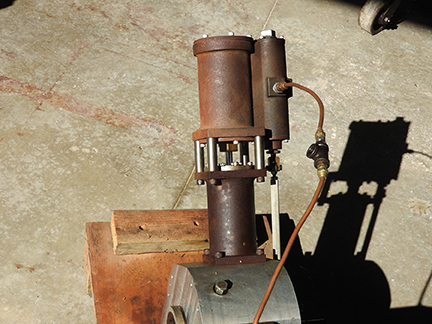
Caption: Shows the cross head and the center admission piston valve. |

|
|
Secondly, one does not see anything resembling an oil pump for injecting steam oil into the steam line to lubricate the piston valves and the pistons themselves. We assume that there is oil in the crankcase and roller bearings and that the splash lubrication will lubricate the main bearing, big and little end bearings, and the cylindrical cross heads.
We also assume that this engine has a long cutoff design such that it is self-starting. Usually, engines are designed so that once started and running at some speed and with an appropriately sized fly wheel (which is lacking) the cut off can be shortened considerably so that there is at least a ten to one expansion of the steam and thus some efficiency. Often cut off is controlled by a centrifugal governor such that at speed the cut off automatically is shortened. |
Caption: Shows the cylinder head and the piston valve head. |
|
|
This is a steam engine and not a steam power plant. For it to become a steam power plant, capable of making power, it will need the following components: some type of a fuel burner, some type of a heat exchanger/steam generator, a water feed pump, an oiler pump, a throttle, a means of varying the steam cut off, and hopefully a condenser and an oil/water separator.
Because Mike Brown never ran his engine on steam he would be unaware of such complexities, which did not prevent him from advertising widely and selling his engine to unsuspecting customers. |
|
 |
| |
This reminds me of a great story, albeit a very sad one, that I heard through the grape vine about a person in the middle of some jungle in Indonesia who desired a steam power plant to provide power because of the isolation. And so, the box with this engine was delivered and without any instructions on how to get it running. The person then called up another steam engine supplier, one who also had a web site and several steam engine models and with considerable knowledge to ask for assistance. To the detriment of the person from Indonesia, the person who knew what he was doing was Australian and they have a reputation for being somewhat curt and to the point. When asked how to get the Mike Brown engine running, the Australian’s response was that he should have ordered an engine from him (the Australian) in the first place—end of conversation.
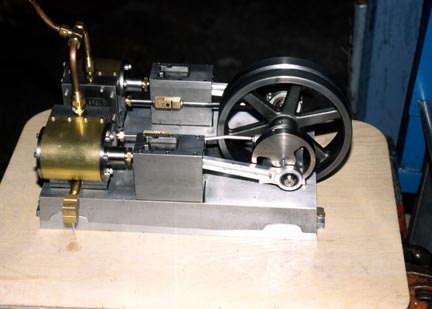
Otherwise, Mike Brown was the only person in production of a reasonably modern design of a steam engine. Semple, out of St. Louis, made some slide valve long cut off steam launch engines of very traditional design, thus not very efficient. The Semple design was copied, but not very well, by TinyTech over in India and advertised widely. At least TinyTech made boilers and ran their engines extensively. We assume that saturated steam was used thus obviating the need for much cylinder lubrication. The Mike Brown saga has not helped the reputation for small steam engines.
|
|